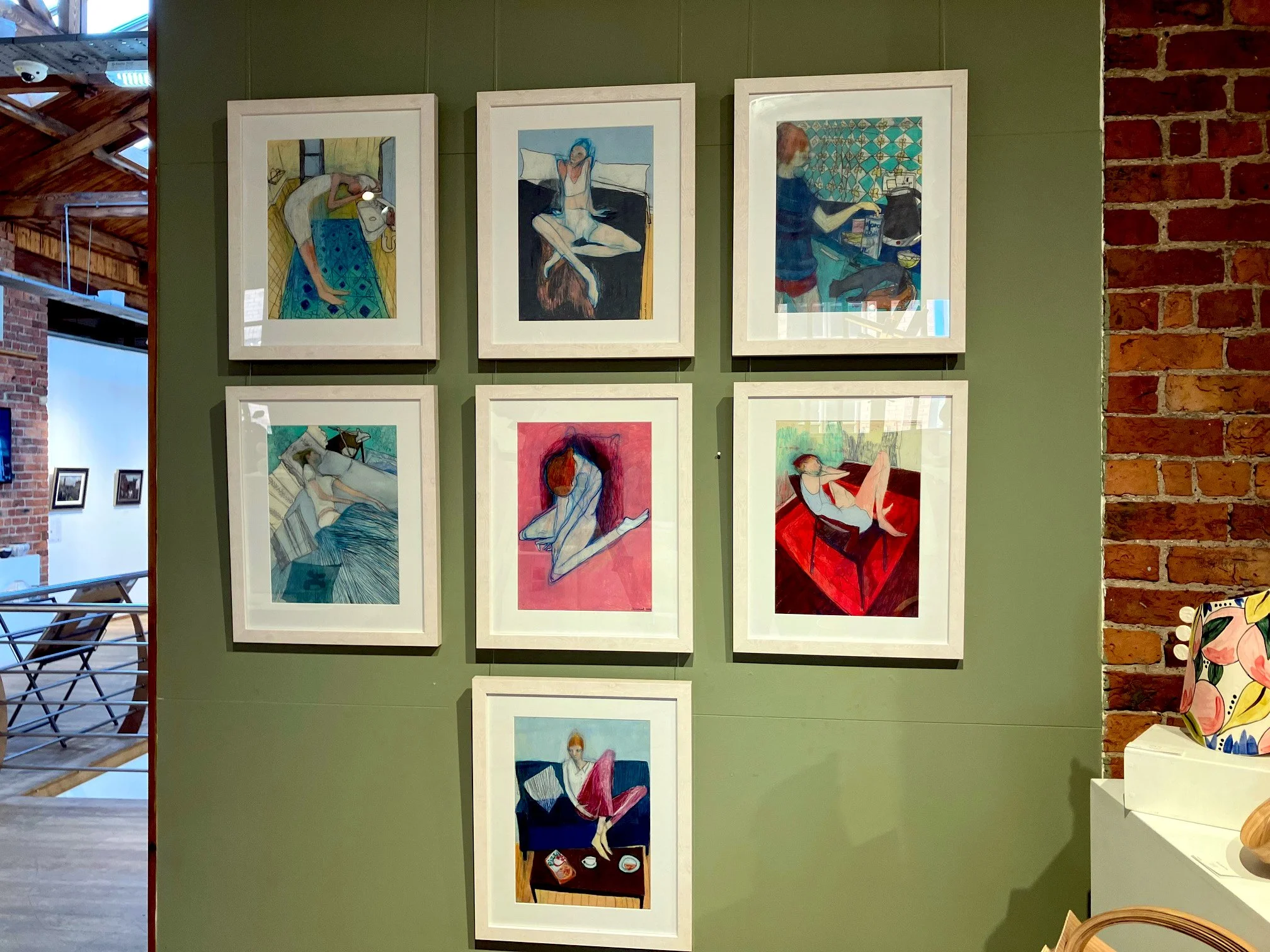
Originally published by The Biscuit Factory in 2023. As the original online interview is no longer available, this updated edition has been preserved here for archival purposes.
Q: Could you introduce yourself and your artistic practice?
I am a contemporary figurative artist based in Copenhagen, working primarily with coloured pencils. My drawings explore memory, solitude and emotional narratives through female figures and domestic interiors. What draws me is how ordinary moments become emotionally charged through memory and observation. Rather than portraying specific people or places, my drawings begin with observation and gradually evolve into more ambiguous, fragmented images that remain open to interpretation. I see drawing as a slow process of looking, where forms appear, disappear and quietly reveal something unexpected.
Q: Why do you choose coloured pencil as your primary medium?
Coloured pencil suits the way I think and work. It is a slow, quiet medium that demands patience and close observation, allowing each drawing to develop gradually over time. I am drawn to its subtlety — colours can be built in delicate layers, while lines can remain visible, creating a sense of fragility and openness. Rather than hiding the process, I want each drawing to retain traces of its making. That balance between precision and uncertainty reflects the emotional atmosphere within my work.
Q: Memory seems to play an important role in your work. Why?
Memory is where most of my drawings begin. I rarely try to record a scene exactly as I saw it. What continues to fascinate me is how memories change over time — what remains, what disappears and what becomes imagined. That process naturally introduces ambiguity into my work. I like the idea that a drawing can feel both familiar and uncertain at the same time, allowing viewers to bring their own memories and experiences to the image.
Q: Your figures often appear fragmented or partially unfinished. Why?
I like drawings that leave room for uncertainty. Leaving areas unfinished allows the image to breathe and remain open rather than feeling completely resolved. Fragmentation reflects the way we experience memory itself — incomplete, shifting and constantly reconstructed. Rather than describing every detail, I prefer to suggest. Those empty spaces invite the viewer to participate, completing the image through their own imagination and emotional experience.
Q: How do domestic interiors influence your drawings?
In my drawings, domestic interiors are never simply backgrounds. They shape the emotional atmosphere of each image. A chair, a table, a window or the quiet light entering a room can carry as much emotional weight as the figure itself. The room matters to me not as a physical place, but as a psychological space where memory, solitude and everyday life quietly intersect. Often, the room becomes another silent presence within the image.
Q: Where do your ideas come from?
Most of my ideas begin with observation. I pay attention to ordinary moments that might easily go unnoticed — someone sitting quietly, light falling across a room, an empty chair or a familiar street. I rarely draw directly from life. Instead, I let those moments settle in my memory, where they gradually change and become something else. By the time I begin drawing, I am no longer reconstructing a specific place or person, but exploring the emotional atmosphere that remains.
Q: Could you describe your creative process?
Every drawing begins with small sketches, observations and visual notes collected over time. I rarely start with a fixed composition. Instead, I allow the drawing to develop gradually, responding to what happens on the paper rather than following a predetermined plan. Some decisions are made intuitively; others require days of reflection. By the end of the process, the drawing often reveals emotional connections that I could not have anticipated when I first began.
Q: How has living in Barcelona, London and Copenhagen influenced your work?
Each city has shaped my work in a different way. Barcelona gave me a lasting sensitivity to light, colour and Mediterranean culture. London encouraged me to observe everyday life more closely while exposing me to a broad range of contemporary artistic influences. Living in Copenhagen has encouraged me to slow down and pay closer attention to quiet, everyday moments. That sense of stillness has become an important part of my recent work. Looking back, I realise these places have not replaced one another; together they have gradually formed the visual language I continue to explore today.
Q: What do you hope viewers experience when they encounter your work?
I hope the drawings encourage people to slow down. We spend so much of our lives surrounded by images that demand immediate attention, yet drawing asks for something different. It rewards patience and quiet observation. If someone spends a little longer with one of my drawings and begins to notice small details, subtle relationships or emotions that were not immediately visible, then I feel the work has done what it was meant to do.
Q: What are you currently working on?
I don't feel that I am searching for a completely new direction. Instead, I want to continue going deeper into the visual language I have gradually developed over the past few years. The relationship between figures, domestic interiors, memory and emotional atmosphere still feels full of possibilities. I'd rather go deeper into these ideas than chase constant change. I feel I am only beginning to understand where this work might lead.